05 Governance
Approval before action.A record after.
Nexus is the trust fabric through every layer: identity, policy at runtime, approval and a run ledger. Compliance-by-design gives you controls and evidence for your own compliance work.
[ 05 ] GovernanceRequest. Approve. Audit.
01 In this layer
Nexus and the trust fabric.
- Approval gatesAvailable
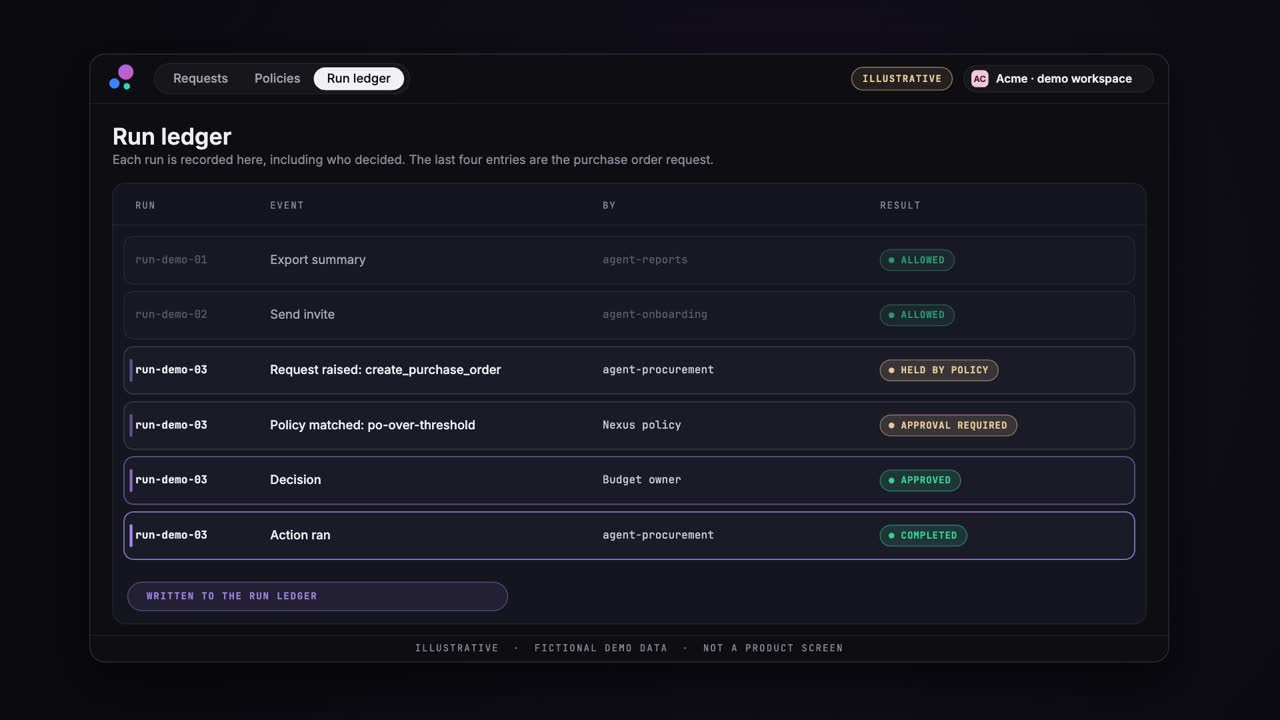
- A run ledger for each runAvailable
- Identity for every agent and endpointDesigned for
- Trace from data to outcomeDesigned for
Nexus
NexusTrust fabricSovereigntyControlled autonomyTrust ProfileTrust centreSecuritySecOps overviewSecOps for AI
SecOps overviewAI SOC agentsAI red teamingPrompt injection defenseAgent runtime securityMCP and tool securityShadow AI discoveryOWASP LLM Top 10AI incident responseAI audit trailEU-first
EU-first approachEU AI Act timelineGDPR for AINIS2 for AIDORA for AIAI Act high-risk checklist02 [ 05.A ]
Policy runs inside the work.
Rules change what an agent can do while it runs: allow, redact, ask or deny. Live today on runs that have a policy attached.
03 [ 05.B ]
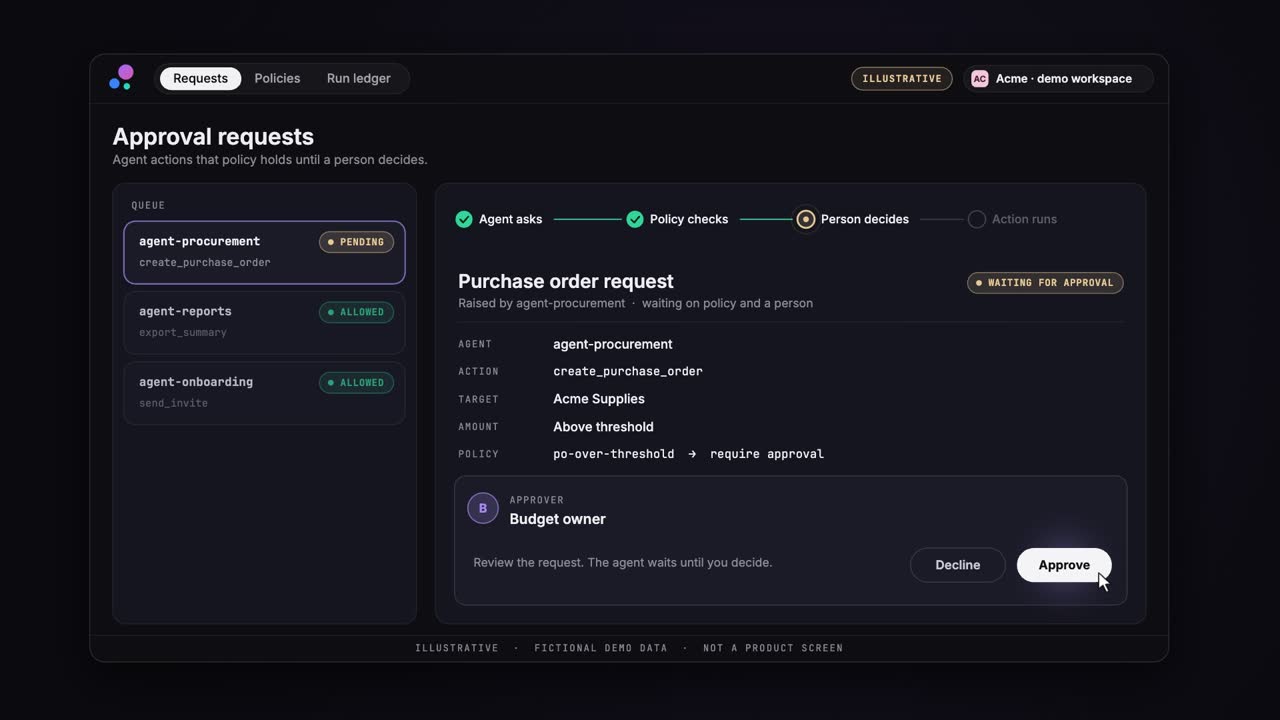
Approval before action.
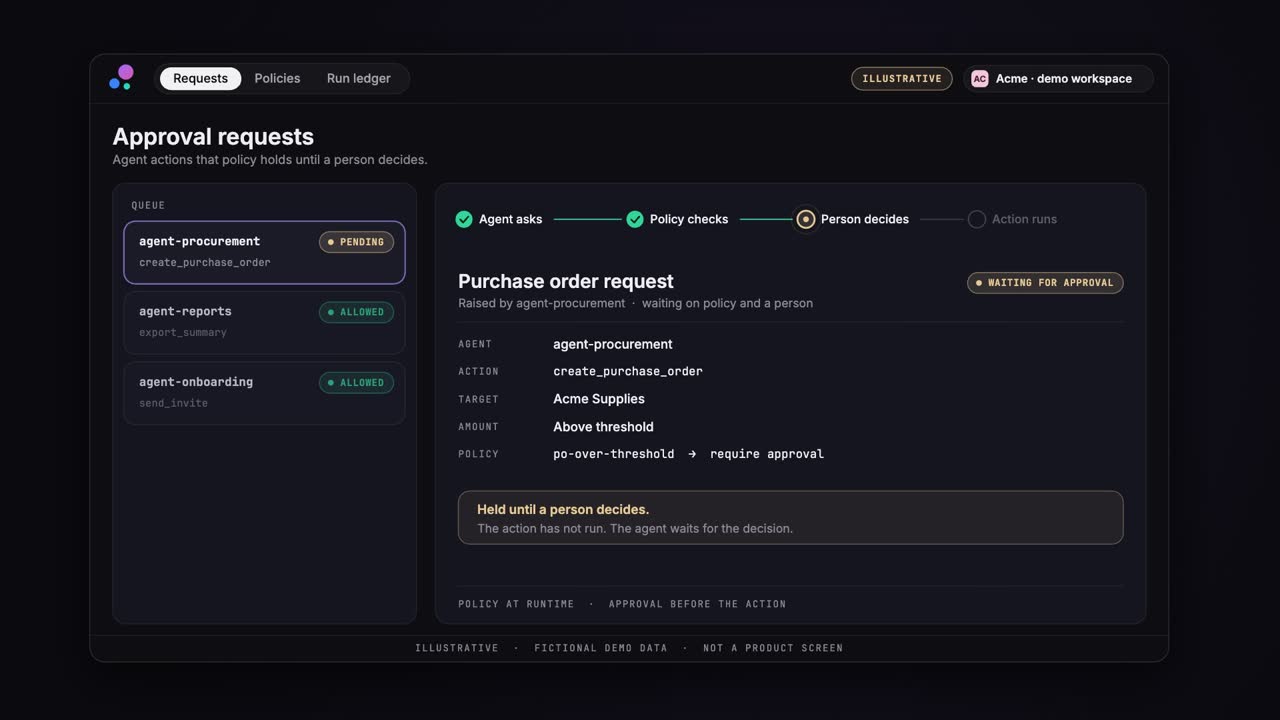
Agent actions can require a person to approve them first, with escalation when nobody answers.
04 [ 05.C ]
One profile per AI system.
A Trust Profile holding owner, risk level, data, allowed actions and approval rules in one record.
05 See it work
Nexus, result by result.
Ask Nexus
Before the procurement agent raises a purchase order above the threshold, ask the budget owner and record the decision.
 IllustrationIllustration
 Illustration
[ 05.A ] Illustrations, not product screens.
06 Controlled autonomy
Choose how much you hand off.
L1 Level 1 of 5
Assist
AI recommends. A person decides and acts.
- The agent
- Drafts, summarises and recommends.
- Your people
- Decides and takes every action.
- Control
- Read access to approved data only.
- Status
- Available today, per agent and per action.
L2 Level 2 of 5
Approve
AI prepares the action. A person approves it first.
- The agent
- Prepares the action and asks.
- Your people
- Approves or rejects each action.
- Control
- Approval gate before anything changes.
- Status
- Available today, per agent and per action.
L3 Level 3 of 5
Supervise
AI acts within limits while people watch the record.
- The agent
- Acts inside the limits of its policy.
- Your people
- Reviews the run ledger and steps in.
- Control
- Policy at runtime, on runs that have a policy attached.
- Status
- Available today, per agent and per action.
L4 Level 4 of 5
Autonomous
AI acts on its own within strict policy and risk bounds.
- The agent
- Completes the job end to end.
- Your people
- Sets the bounds and audits the outcomes.
- Control
- Risk bounds, escalation and approval above thresholds.
- Status
- Designed for. The platform position, not yet a shipped setting.
L5 Level 5 of 5
Adaptive
AI improves how it works, inside controlled boundaries.
- The agent
- Learns from outcomes within its bounds.
- Your people
- Owns the boundaries and approves changes.
- Control
- Changes to behaviour stay inside the boundaries you set.
- Status
- Designed for. The platform position, not yet a shipped setting.
Trust Profile Designed for
Every agent has a profile.
Who owns it, what it may touch, what needs a person and how it is recorded. The controls exist today as separate pieces; one record per AI system is designed for. A worked example:
About Trust Profiles- Owner
- Customer Operations
- Risk level
- Medium
- Approved models
- Model A / Model B
- Data classification
- Confidential
- Data residency
- EU
- Permitted systems
- CRM / Knowledge Base / Ticketing
- Allowed actions
- Read / Recommend / Draft
- Restricted actions
- Account modification / Refund
- Human approval
- Required for refunds above threshold
- Retention
- Defined organisational policy
- Audit
- Full action trace
- Policy set
- Corporate AI Policy / Customer Data Policy
Thirteen facets of the fabric
These apply to every layer, from infrastructure to solutions.
- Identity
- Access
- Data controls
- Policy
- Security
- Privacy
- Compliance
- Risk
- Human oversight
- Auditability
- Traceability
- Evidence
- Monitoring
What each facet does
- IdentityEvery user, agent and workflow acts as a known identity.
- AccessPermissions scoped to each identity, tool and data source.
- Data controlsClassification, residency and boundaries applied to what AI can read and write.
- PolicyRules that change what an agent can actually do, not what a document says it should do.
- SecurityProtection for the runtime, credentials and tool connections AI depends on.
- PrivacyHandling of personal and sensitive data in prompts, context and outputs.
- ComplianceTechnical controls and evidence, built in by design, for your own regulatory requirements.
- RiskRisk levels and thresholds that decide what needs approval.
- Human oversightApproval, escalation and review points where people stay in charge.
- AuditabilityA record of what happened and under which policy.
- TraceabilityThe chain from data to model to agent to decision to action to outcome.
- EvidenceRecords you can hand to a reviewer, an auditor or a regulator.
- MonitoringA live view of behaviour, cost and policy decisions.
Runtime, not paperwork
A policy that lives in a PDF changes nothing about what an agent does at two in the morning. On this platform, governance is designed to be enforced inside the AI runtime: a policy change alters what the agent can actually do, on the next action.
The traceability chain makes that checkable: data, then model, then agent, then decision, then action, then outcome. Each link is recorded, so a result can be followed back to its causes.
Guardrails and governance are different questions
Guardrails answer: should this be blocked? Governance answers: who is acting, allowed to do what, under which policy, with which data, using which model, at what risk, with what oversight, and can we prove it? A governance decision is one of six verbs.
- AllowThe action is within policy and proceeds.
- DenyThe action is outside policy and is stopped.
- WarnThe action proceeds, and the risk is flagged to the right people.
- FilterThe action proceeds with sensitive content removed or masked.
- EscalateThe action is routed to a person or team with authority to decide.
- Require human approvalThe action waits until a named approver says yes.
A Trust Profile for every AI system
The Trust Profile is a design concept: one record per AI system that states what it is and what it may do. Today these controls exist as separate parts of the platform (policy engine, approvals, run ledger) and are not yet joined into a single record. The profile is designed to hold:
- Identity
- Owner
- Risk level
- Approved models
- Data classification
- Data residency
- Permitted systems
- Allowed actions
- Restricted actions
- Human approval rule
- Retention
- Audit
- Policy set
Worked example: an AI Procurement Agent
One agent, four lists. The agent’s authority is explicit, and so is the evidence it leaves.
AI Procurement Agent
- Can
- Read approved supplier info
- Analyse contracts
- Compare pricing
- Prepare purchase recommendations
- Create draft POs
- Cannot
- Access unrelated employee data
- Approve its own high-value transaction
- Make payments
- Modify restricted records
- Requires approval
- Purchases above threshold
- Contractual changes
- Sensitive external comms
- Records
- Identity
- Data accessed
- Model used
- Output
- Tools called
- Policy applied
- Decision
- Approval
- Action
- Outcome
Compliance-by-design
Swfte provides the technical controls, governance mechanisms and evidence required to deploy AI within an organisation's applicable regulatory, security and policy requirements. The exact posture depends on the customer's use case, jurisdiction, deployment and configuration.
Compliance-by-design means the controls and evidence are part of how the platform runs, so your teams can use them in their own EU AI Act, security and policy work. It does not mean that using the platform satisfies your obligations on its own. For what Swfte can and cannot show today, read the trust centre.
Where Swfte products take part
Product names are kept. Each is an entry point into the platform.
- NexusCaptures every agent action, enforces policy in-flight and traces every agent and connection.Open Nexus
- CortexAnswers from your files and meetings, runs on the laptop by default, and puts engineers’ AI agents under one policy and one audit trail.Open Cortex
- StudioBuild agents, chatflows and automations without code.Open Studio
What this means for your team
- CISOGive AI identity, permissions, policies and auditable controls.
- Legal / ComplianceMake AI activity traceable, governed and evidential.
- Chief AI OfficerMove from AI experiments to governed production AI.
Frequently asked questions
What is an AI governance platform?
A platform that controls what AI systems may do and records what they did. On Swfte that means identity, access, policy, risk thresholds, human oversight, auditability, traceability and evidence, designed to work at runtime across every layer.
What is the difference between guardrails and governance?
Guardrails decide whether an output or action should be blocked. Governance covers who is acting, what they may do, under which policy, with which data and model, at what risk and with what oversight, and whether it can all be proved.
Does Swfte cover our EU AI Act obligations?
No platform can discharge an organisation’s obligations by itself, and we do not claim it. Swfte provides technical controls, governance mechanisms and evidence that support your own programme. The exact posture depends on your use case, jurisdiction, deployment and configuration.
What is compliance-by-design?
Building controls and evidence into how AI runs, instead of adding them afterwards. It gives your compliance and legal teams records to work with.
What is a Trust Profile?
A record attached to each AI system that states its identity, owner, risk level, approved models, data classification and residency, permitted systems, allowed and restricted actions, human approval rule, retention, audit and policy set.
Which Swfte product enforces policy?
Nexus captures agent actions and enforces policy in-flight. Cortex puts engineers’ AI agents under one policy and one audit trail. The fabric spans all layers, so other products take part through their own controls.
Across every layer
These ideas apply to every layer of the platform.
- Controlled autonomyFive levels, from AI that recommends to AI that adapts within limits.Open
- Trust ProfileThe record that describes what each AI system is and may do.Open
- AI sovereigntySeven kinds of control over your AI estate.Open
- Swfte Intelligence PlatformAnalyse and visualise your data, usage, agents and outcomes, then build from what you see.Open
- Company brainOne governed place for everything your organisation knows, for every product to read from.Open
- Custom modelsModels adapted on your own data, evaluated before release and deployed under your control.Open
- How Swfte builds with CortexAn honest first-party account of how we build, review and approve work, labelled by status.Open
- Governed agentsIdentity, permissions, policy, approvals and audit for agents, with ten templates.Open
- Compliance-approved workflowsWorkflows with approval gates and evidence built in, with twelve templates.Open

[ 07 ] One platform
Capability and control, in one platform.
Start with one layer and prove it. Add the next when you are ready. The controls come with you.